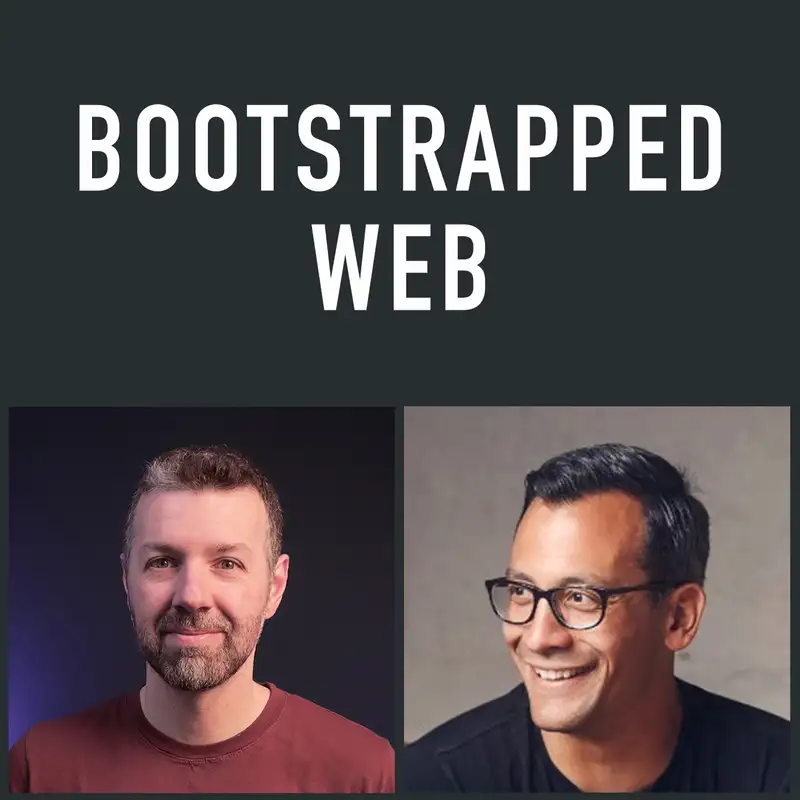
Our final episode (for now)
Hey. It is Bootstrap Web. It we are now in 2025. Jordan, how are doing, buddy? We've got a big episode here.
Jordan Gal:We do have a big episode. Brian, it's great to see you. Of course. Not not our regular Friday.
Brian Casel:It is a Thursday Yeah. Because I I did not work last Friday and I don't intend to work tomorrow, Friday. Okay. Okay. I'm I'm trying to stick with it.
Brian Casel:So Cool. But let's let's not bury the lead here.
Jordan Gal:Yeah.
Brian Casel:We're gonna call this the final episode for now, I think. Yeah. You know, this we're we're gonna take a big time out on on Bootstrap web. That's sort of the headline and Yep. You know, I guess we can think of this as like a final episode but don't unsubscribe to the feed.
Brian Casel:Just leave it on your phone or whatever. We might pop in here, I don't know, in a few months, maybe later in the year, whenever with just a a quick update from us to to check-in. But you know, we're gonna we're gonna stop regular episodes going forward.
Jordan Gal:Yes. Yes. This is a finale in some ways. We're not gonna stretch it out to ninety minutes and make it like a movie. No.
Brian Casel:We're we're not gonna do like a montage.
Jordan Gal:Be relatively short because I gotta I gotta hard stop in forty minutes. But yes, you know, the the way the way I'm looking at it is we are calling a time out on regular weekly episodes. Yeah. I think both of us are full. Yes.
Jordan Gal:We got we got a whole bunch of stuff going on. It's been such a great experience. It's hard to even, you know
Brian Casel:Yeah.
Jordan Gal:Take it all all in and I think because that I'm not willing to say it's over.
Brian Casel:You know me too and when we were chatting about this the other day I think you and I both had the same feeling about this conversation which is like man we are so torn because it's like we love doing the show. Yes. We love talking to each other and of course we love doing this feed for for all the listeners. I like I very much feel like I am a fan of of the show as as as weird as that sounds but like I'm a fan of this show too, you know. I was just digging up some stats this morning.
Brian Casel:Okay. So I and it's weird because the the really old one, there's like some missing episodes in in the very beginning. Sure. So the very first episode, I I started it alone in May, on 05/31/2013. That's over eleven years ago.
Jordan Gal:Oh my god.
Brian Casel:It was the first episode of a podcast called Bootstrapped Web. You joined me, I I I see there's like a gap in the first like 20 episodes where where we're missing some, so I I don't actually have your first episode I think in in Castos, but I think it was around April 2014, thereabouts.
Jordan Gal:Ten
Brian Casel:years. It's been like over ten years with with you and me on the mic.
Jordan Gal:That's a trip. It's been it's been fun. I am so happy that we have that documented.
Brian Casel:Yeah. The total number says 324 episodes. I think there's been a few more than that that that got lost.
Jordan Gal:Yeah. Cool. But We were we were consistent with it for a long time and I don't know what it is. You know, so we were torn, right, when we talked because we don't we don't wanna stop doing it. But what's the other side?
Jordan Gal:If we're torn, that is almost like the easy default, like emotional, like, I don't wanna stop. You know, it's it's fun. What what's what's the other side? What's doing it for us? What what's pulling us in the other direction saying, no.
Jordan Gal:You know what? I think I I gotta spend my time differently. I gotta do different podcasts. I'm going this direction.
Brian Casel:I Yeah.
Jordan Gal:I I have some thoughts. Well, what
Brian Casel:Yeah. Well, first, just on the thought to say, like, like what you were just saying, you know, we're we're torn, we're thinking about it, maybe that's enough to say let's put a pause. Mhmm. It it make it reminds me of I've heard Jerry Seinfeld say this a bunch of different times and also Larry David about the Seinfeld show. They they feel like they ended it sort of like at its height before it became bad essentially.
Brian Casel:I don't not that I would expect us to to go bad or anything but like, you know, Seinfeld has also talked a lot about this as well like just with like comedy sets. Like you wanna you wanna leave the audience like about ten minutes before they get bored. Yeah. That that thought has been rattling in my mind.
Jordan Gal:Just not trying to get out or getting to a point where we're doing episodes that we don't really wanna do.
Brian Casel:We don't we don't wanna make it a chore like, you know. Yeah. I think you know another thing that we were chatting about the other day was like as we head into 2025, as I said like I'm being very intentional about my time. I'm trying to go to four day work weeks. And I think we're both trying to be very intentional about everything we do and what we commit to and where we're putting our energy and focus and time.
Brian Casel:And you know, like you make a list of all the things that you do and like this is one that's like, I don't know, do we have to keep doing it? It has been eleven years, you know?
Jordan Gal:Yes. It right. It should it it should not feel like obligation because it isn't one. And, yeah, I I feel pretty full Mhmm. Right now.
Jordan Gal:You know, I think we we talked a little bit about the last six months for me and things have gotten harder recently. And what I mean by harder is like there's just more work to do. In some ways because Rosie is working where Rally was not.
Brian Casel:Mhmm.
Jordan Gal:But it really I feel very focused. Like, no no bullshit. I'm just trying to I'm just trying to execute.
Brian Casel:Yep.
Jordan Gal:You know, we had we had a great all hands yesterday and we tried to change it up. We said, alright. It's twenty twenty five. There's six of us. Let's take advantage of the fact that there's six of us and instead of having, you know, Jordan and Rock talk about what's going on and maybe a few slides from Sam or Jess it's kind of like let's all talk.
Jordan Gal:So we started to do this thing where each individual has a few minutes to present something and the goal is basically to add your perspective. That could be here's what we're not doing that I think we should be. Here's what we're doing that I think we shouldn't be. Here is how I'm approaching development in an AI universe where I can't track when I release changes. Normally, can just track and analyze how things are going and now it's kinda like, well, this AI is off talking to people and I don't know how to track that.
Jordan Gal:So let me give a presentation on Langfuse on how were you so right. So all these individual things. My presentation, the way I thought I could add the most value is just open kimono finances. I just said, here's where we are. Here are the projections.
Jordan Gal:Here's what happens to revenue, expenses, cash in the bank, and burn every month for the next twelve months based on these projections. And I want everyone to take it in and feel good about the transparency and take on the stress that goes with it. Yep. And it really helped me because it felt like I was holding that in and dealing with that pressure and stress myself and opening it up felt good like sharing that. But what it also goes directly to is feeling pressure.
Brian Casel:Yeah.
Jordan Gal:And I think that connects directly to being very mindful of how we spend our time and how productive we wanna be. And this podcast has turned into something that's fun. And it's not like I wanna eliminate fun. I don't have time for any fun, but it does feel like, hey. If you don't wanna work on Fridays and I like to do the podcast on Friday because Friday is my more chill day, then it starts to move over into my Thursday.
Jordan Gal:Thursday is I'm still I'm still in killer mode. I wanna stay in killer mode. So I think that's kinda what brought us to, hey, you know what? Let's just call a little time out, do a quarterly update but not put that pressure on ourselves to make it work even though it may not fit.
Brian Casel:Totally. Yeah. I totally feel you on that and and I I know that like I think my taking Fridays off sort of probably triggered the conversation but I feel the same way too. Because like I I I also now feel a pressure of like I need to ship everything I need to just need to ship between Monday and Thursday. Mhmm.
Brian Casel:You know? And you know, one of the other things that that I've been torn about probably for quite some time I think with this podcast. If I'm being totally honest is like I always, like like you said, like we both have fun doing it, we both really enjoy it. Know, but I also feel like I I get other benefits from doing, from podcasting and being in public
Jordan Gal:Mhmm.
Brian Casel:Including this show. And and I always felt like I probably receive more business benefits and network benefits for my business and work than you probably do. Yep. And so And then that that also led to sort of like a hesitation for me to you know end the show. You know, like do I really want to like stop being out there every week the way I have been?
Brian Casel:Because the the truth is like I've had so many positive benefits to my work through through this podcast specifically. I mean, yeah, I started to jot down a few here like I'd say like number one, it keeps maybe this is for both of us but like it it keeps it definitely keeps me sharp.
Jordan Gal:Yeah. The muscle? Yep.
Brian Casel:You know, like being here on the mics like it it knowing that I have to like report to an audience and and like talk about what what I'm doing with my business, and make a case for it, and know that like there's gonna be listeners who are driving in their car and thinking like Brian's such an idiot, why is he doing that? And I and I In my mind, I have to like try to, you know, argue against them.
Jordan Gal:I'm gonna say that that's 80% positive and it does actually come with a bit of a negative impact around I don't know. Sometimes you don't need justification. It's just because I felt like doing this and I don't wanna do that anymore.
Brian Casel:Exactly.
Jordan Gal:I don't wanna be consistent.
Brian Casel:You're you're right about that. I actually jotted down here. Was like like both the good and the bad pressure. Like there there is the good. It it it I think it does actually for at least for me like force me to follow through on the things that I talk about here.
Brian Casel:Mhmm. But there is the bad. Like like like you said, like it I overanalyze. I I I think about a lot of mental bullshit that doesn't even need to be there. So there's that.
Brian Casel:But the the other the other big one for me is it is the best networking tool that I know of. Especially for someone like me. Like in real life, I am an introvert.
Jordan Gal:Yeah.
Brian Casel:I I am very much like we're very different in this way probably. Yeah. Like I am not a networker. You know? But having this podcast has supercharged my professional network.
Brian Casel:Like there's just no doubt about that. I've been invited to conferences, I've been you know, all this like clients have come through the podcast, referrals, introductions, hires, team team members, partners, partnerships have come through the podcast. Like, all sorts of stuff that like I yeah. I I wouldn't have just like networked my way there.
Jordan Gal:It's it's like you get to start on, you know, step five of 10. Yes. You know, I I will always remember the first time I went to MicroConf after we started this podcast. And it went from, I'm an anonymous person and I'm going to network my way into relationships to, I listen to your podcast, handshake. Mhmm.
Jordan Gal:And that is like, it is starting at at 9.5 out of 10 on the networking scale. It is just this acceleration. Now what happened over the last few years is I started to look at this as just fun. I don't get any business benefit, not direct. And maybe you are better off on a more consistent basis.
Jordan Gal:Let's say a weekly commitment type of a thing doing something like this with someone that is also getting business benefit because it just increases the motivation, the seriousness. Sometimes I feel a little bit like a slacker because I don't get any business benefit. It's just fun. I maybe don't prepare quite the same way as you would be honest.
Brian Casel:You know, but you know, I mean it's funny that you say that. I actually am jumping jumping onto another podcast pretty
Jordan Gal:soon. Right.
Brian Casel:I You know, I'm talking to Justin Jackson. He and I are starting up a totally new show. It's called panel. It's called the the panel podcast. You can get it at panelpodcast.com.
Brian Casel:That's that's the official announcement. Yep. I think actually later today, we're gonna be recording the trailer episode and the idea is that it's Justin and me co hosting but we're gonna be bringing on a panel every episode with like one or two other guests. Jordan, we definitely gotta wrangle you in there.
Jordan Gal:Part of this arrangement is an agreement to, you know, with a minimum number of appearances on the panel.
Brian Casel:Yeah. X number of
Jordan Gal:Yeah. But Justin is not going to do a podcast, hang up, and then not share it the way I do because I I don't remember to because I just had fun with you talking and I don't I'm not looking for anything beyond that.
Brian Casel:Yeah. Yep. Yeah. And, you know, that's gonna be a different show, different different vibe. But, you know, if you listen to this, you you probably know Justin and and me and people in our circles.
Brian Casel:We're gonna bring them on and talk about you know, all all sorts of stuff. So Cool. We have an email list if you wanna get on on the launch thing there. That's at panel podcast dot com. But I mean other than that like, you know, like because I I as I said like, the the other big benefit and and going forward for me like, it it's also been very important for me to build in public and to share everything that I'm working on publicly.
Brian Casel:I know that not everyone operates in business this way but I don't know what it is about my personality or or what it is but like I I feel uncomfortable when I'm working super privately and I have projects right now that I have not announced publicly and and it and I'm feeling I'm already feeling that that discomfort with like I've been working for weeks on this thing and nobody knows about it. Like this doesn't feel right. I I need to I need to tell and show the work and I I saw that I saw this podcast as a as a big outlet for that. You know, I have other outlets for that. You know, social media, my my newsletter.
Brian Casel:I I do have a private podcast called called What's Next. You can get all that at my my personal site, briancastle.com. So I I continue to post there just like sharing notes on updates on on what I'm working on. So, you know, like I I don't know. Like it's it's just again like I Maybe it's like the since I work at home and I'm all alone in here, I I feel like I I I don't have like a team culture vibe like like you have.
Brian Casel:So I feel like I have to like show other people what I'm doing, you know.
Jordan Gal:Yeah. Well, I think that muscle has benefited you tremendously in that that set of habits. So I think you'll do more of it outside of this podcast. Yeah. Yeah.
Jordan Gal:And I don't know what I'm gonna do if anything. I might just take a little break and just kind of look inward. You know? And why don't we get into a little bit of of an update? Mhmm.
Jordan Gal:Because the intention is to do something quarterly.
Brian Casel:Yeah. I I was gonna say, I I actually think that this can make for a really interesting thing where like if we talk about like what what our plans are for the upcoming year Mhmm. And we catch up for five six months from now, it'll be really interesting to sort of see how we did on
Jordan Gal:on what we said. That's right. It's kind of a it's a different it's a different time scale.
Brian Casel:Yep. And so instead
Jordan Gal:of what am I weekly, weekly, weekly to go a little bit more, you can kind of see progress in a different way.
Brian Casel:Yeah. I think it'll be actually really interesting to like listen back even just six months ago to say like, oh, was saying that. Yeah. That did not turn out
Jordan Gal:the And it goes by. It it does go by fast. You know, and now I have I have board meetings quarterly.
Jordan Gal:Mhmm.
Jordan Gal:So I I have that time frame as part of my, like, business habits, and it is it is cool to see. Sometimes it is embarrassing in terms of, you know, making plans and stating them and then three months later you're like, that was completely wrong and we went in a different direction and here's why and
Brian Casel:I'm always surprised both ways, both positive and negative. Like I'm I like I just looked back at 2024 at my revenue numbers and everything, I'm like, oh, it actually ended up like a lot better than I than I expected that it would at the start. But then there's also other things like oh, I'm gonna build this and launch that and like those just never happen. Yes. Yes.
Brian Casel:So what can you, because you know, we talked a lot offline about our businesses and stuff. Of course we can't share everything but like what, if you had to sort of predict or project out what your 2025 is going to look like and and or what you hope it will look like for you Mhmm. What do you what do you see?
Jordan Gal:I I I'll take q one on.
Brian Casel:Mhmm.
Jordan Gal:Twenty twenty five seems like too big of a bike.
Brian Casel:Too far.
Jordan Gal:Yep. But but the q one feels right. So I'll I'll give you I'll give the quick update. Before we left for break, call it mid December. When we left, we were not sure.
Jordan Gal:I was not sure. And as a team, we were not sure if we had made the right decision in switching from time based trial, seven days and you convert regardless of your usage or adoption. We switched over to usage based. So you got to use the product fully without a credit card and you only converted when you went through fifty minutes of call time. We try we we did that for a very specific reason and it's not for revenue growth because revenue growth looked beautiful at the seven day trial.
Jordan Gal:But if you take one teeny tiny look under the covers sorry about that. FaceTime. So we we are not new at this. Right? I'm not an amateur at software.
Jordan Gal:I've kinda seen some good and some bad, and I knew we were building our castle on sand, on quicksand. Because if you look at if you look at usage in that scenario, if you force everyone to convert, if you force everyone to put their credit card on and then seven days later they convert, an unhealthy percentage of your user base does not use your product. And so the revenue growth looks good but it is not good. We wanted to go the other extreme. We wanted to say you only convert if you proactively put your credit card in and you are actively using the product.
Jordan Gal:Because this AI thing is a question mark. Is it good enough to answer people's phones? Do people feel confident enough? And so we wanted to really test out like what's going on here. How healthy is this product and business?
Brian Casel:Yep.
Jordan Gal:Between then, one very important thing that we did right before we left. So like December like sixteenth or seventeenth, I just kinda woke up one morning. It was like fifty minutes is too many. Let's move to 25.
Brian Casel:Mhmm.
Jordan Gal:Because I thought same thing in terms of usage and adoption. You're effectively using the product at twenty five minutes. People test people test for between five minutes and maybe ten minutes at most.
Brian Casel:Yeah. Twenty yeah. Twenty minutes Twenty five minutes. Same thing.
Jordan Gal:Because we we count by the seconds. So if a phone call takes fourteen seconds, it eats up fourteen seconds of usage, not a minute. So twenty five minutes is like actual usage. And I thought that would have no negative impact on sign of conversion whatsoever. So I just didn't see any downside.
Jordan Gal:So we made that switch and that switch turned out to be right. So both things, now that we're in January, we now have the confidence that both of those were right. The move from time based to usage worked. Now we knew when we made that switch that we would kind of eat it for a few weeks because conversions would disappear because the cohort of seven days disappears and you start up with a new cohort of usage first fifty minutes then twenty five. So you get a bunch of sign ups and nobody converts because they have to work through their fifty minutes.
Jordan Gal:Mhmm.
Jordan Gal:So we Yeah. Were hoping, okay, at some point, this should all hit at once as this cohort goes through their usage.
Brian Casel:Yeah.
Jordan Gal:And so it was a stressful few weeks. Yeah. And then sometime toward the December, then we also made the twenty five minute switch and then all of a sudden all at once. Bang bang bang bang bang bang conversions every single That
Brian Casel:is so cool. It's awesome dude. I I and you know, I I was gonna do like my side of the update. I I will talk about instrumental products since that's like the majority of my time and focus and energy like getting this new business shaped and formed into what it's gonna be. But before I get there, I'll I'll do a quick note on Clarity Flow because it's pretty similar.
Jordan Gal:Okay.
Brian Casel:Even though this is like the the 20% of my time and focus. I I've been talking about the experiment that I've been running since August. So August through the 2024 has been no trial. We charge you on day one. Like you pay on day one to get into Clarity Flow.
Brian Casel:And at first, the first couple of months of that I thought that it was working pretty well, but I was keeping my eye on everything. All the cohorts coming through those months and and their performance in terms of churn and and and all that. And here we are, what, five months later? You know, like around around December, December, I was like, this is The cohorts aren't as pretty as as the ones that came before them. So we're the the new experiment that will be going live like tomorrow or Monday is we are returning to to free trials, fourteen day free trial.
Jordan Gal:Okay. So this is gonna define your q one here.
Brian Casel:Yeah. For sure. On Clarity Flow. Yeah. Totally new math equation to to work out going forward.
Brian Casel:For This is just the next experiment. I don't I don't know how many more months we're gonna try this one. Maybe revert back. I don't know. But this is a new experiment though.
Brian Casel:We had trials before but a few variables are different this time. One is we just have more traffic now than we had before, like a lot more traffic. We have more leads, more word-of-mouth. So it'll be interesting to see how how those react to a trial. And then we are doing credit card upfront trials.
Brian Casel:Whereas before we did not have credit card upfront. Okay. Before it was you start a trial and then you put your credit card in once you want some premium features or or at fourteen days whichever comes first. Now it's credit card in on day one, then you do your fourteen day trial and we will automatically bill you on day 14. That's variable number one.
Brian Casel:Variable number two is we are now introducing a paid setup service. So Okay. This is totally new, never tried this before. You sign up on day one, you put your credit card in, you get to a success page, and on that success page, we have like a second sales page that says like, hey, welcome to Clarity Flow, glad you're here. Here's a button to purchase.
Brian Casel:It's optional but you can purchase and we like strongly recommend it, big button, big video to present it. Purchase the setup service, you get a strategy session with with Cat, our customer success. We're gonna set you up, we're gonna import your content, we're gonna set up your automations, your courses, all this stuff. That's a one time fee. Right now we're starting it at $400.
Brian Casel:The plan is if if it works, we're gonna just ratchet that number up throughout the year. Mhmm. And you know there's a small link there that says like, no I'll skip for now. I'll I'll just explore my own and then we've got a big link that you can come back and purchase it if you want to. So the hypothesis on this is number one, we It's weird like different variables cancel each other out.
Brian Casel:So like we we should expect more trials than we had in the previous phase of trials because now we have more traffic.
Jordan Gal:Mhmm.
Brian Casel:But we should expect less trials because now we're requiring a credit card whereas before we were not. So it'll be interesting to see like literally how many trials do we get in a month at
Jordan Gal:Before you had no credit card required, then you had no trial. Now you have trial with credit card. Yes. Yeah. What I like, what you played with in the experiment around no trial was basically forcing skin in the game.
Jordan Gal:You can't just come in here create an account look around. Yeah. We want you committed and now it feels like what you're doing with this optional setup fee is making like different levels of skin in the game. Like putting a credit card on file for a trial, that's some skin in the game and then paying a few $100 is like, well now I am choosing to put skin in the game.
Brian Casel:Yeah. Yeah. Okay. It's And and the setup thing is like, it's not just about obviously, like it's not just about just more revenue. It's not and yes, like, yes, it is more revenue, and yes, it is more skin in the game.
Brian Casel:So so that expectation is there, but it's also like, it literally is a ton of work to set up Clarity Flow for your coaching business. Like you you are like customers spend a whole month setting their business up on Clarity Flow. Okay. They have like a thousand emails back and forth with Kat during
Jordan Gal:that month. Okay.
Brian Casel:So this is part part of it is like literally to make her job more efficient. And we know that like when she does work directly with with customers, they're they're gonna stay on and be successful. It's the ones that like choose not to book. Like we we've been offering like really like like free calls and and all this stuff but like now it's like you could still get a free call, you could still do free customer support but like if you if you We're really kinda pushing this as as the option. That'll be interesting.
Brian Casel:We are gonna launch another feature pretty soon for tasks. Coaches really wanna track tasks with our clients. But like beyond that, like we don't have a ton in the roadmap. So it'll just be interesting to see where we end up with Clarity Flow. I would say probably around May, June is when I'll I'll really wanna evaluate how how these months have gone.
Brian Casel:You know? Very
Jordan Gal:cool. Yeah. Very interesting. The right. The the real the real thing that gets opened up by us concluding that it was the right move to go toward usage based is that like we almost move on to the next step of the funnel.
Jordan Gal:Right? We and and all hands, one of the slides I have at the beginning of every single every time we talk is I break down the funnel into different steps and I basically say, we are here. We are focused here. There's other stuff after this but right now we gotta focus here.
Brian Casel:Mhmm.
Jordan Gal:And this all hands allowed me to basically say we're moving from one to the next. We're moving from do people activate? Do people use this product? And that question mark has been answered with a check mark. Yes.
Jordan Gal:They do. Now we know they do. And then the next step in the funnel is like, well, how are you gonna convert and monetize them?
Brian Casel:Mhmm.
Jordan Gal:And so the this quarter is going to be all about that step of the funnel. We have features. We have we have five features that are coming up. None of them are earth shattering. There's a few that people really really ask for.
Jordan Gal:Call transfers. People really want to be able to say Oh,
Brian Casel:like like from the AI to a human?
Jordan Gal:Yes. Yep. Yes. And there's different versions of that. The basic version that we'll launch first is you wanna talk to billing?
Jordan Gal:You wanna talk to marketing? You wanna talk to Stacy? You know, just say the word or say or the number or whatever and then gets forwarded to a phone number. That's the basic version. The high level version is live transfers.
Jordan Gal:You wanna talk to George? One sec. Right. Rosie calls George, says, hey, George. Do you wanna answer the phone?
Jordan Gal:This is a phone call from this person and this person. And And depending on what George says, yes, transfer, no, take a message.
Brian Casel:Interesting.
Jordan Gal:Okay. So cool. Like features like, oh, it's straightforward. But really the work that is gonna be focused is how do we allow people to see the features that are at the higher tiers and how do we allow them to self serve. Right now you can self serve and you can pay without talking to us and that's working great.
Jordan Gal:But if you want to go up to the higher tier, there is the paths are ugly. You can't you're looking at the marketing site, then you go into the product that you don't see those features, so you have to email us and we say, yes, we'll open those up but those are in beta. Here's the link to you know, it's like
Brian Casel:the that I've always approached that is I show all the buttons in the interface all the time.
Jordan Gal:That that is what we're building in January.
Brian Casel:Yeah. So Like all the buttons that are in the premium stuff, like if you try to click it and it's not in your plan, it just kicks you to the upgrade screen.
Jordan Gal:Okay. So you and I gonna have a conversation after this because that is what we're working on right now. So top add more of the top of the funnel and then figure out how to convert and monetize. That that is our q '1. So next time we talk, we'll be talking about how did q '1 go.
Jordan Gal:Did your average revenue per user go up? Are people upgrading on their own? Are you attracting larger customers because you're doing a better job showing the bigger features and and and that type of thing? That's that's the goal.
Brian Casel:Nice. Nice. I'll do a quick update on instrumental products. I feel like the the phase that I'm in in this business, it started I don't it's a gray area but like sometime midway through 2024 is when this like company started Instrumentl Products. When I started doing one month app MVP as a service, you know, Rails apps for for clients.
Brian Casel:And I've had a bunch of those in the in the portfolio over the last couple of months, still actively finishing up three of them right now. At some point, I would like to do like a series of case studies on these. That's some that's sort of on the on the never ending to do list and really start to promote the the apps that that that we've built. The thing But like I still feel like this whole company of instrumental products is in it's like infancy and it's and it's like a big ball of clay that I'm still shaping into figuring out like what is what is it that I'm building here. The the one thing that I know for sure is like this brand, this company exists for builders.
Brian Casel:We are building for builders. We have Right now we have services that we offer to Like if you wanna build a product, can hire us to build your product. I'm actively building components for Rails. Those are for builders. Believe it, this is the first time I'm mentioning it but I actually started building a an editor for Rails.
Brian Casel:Like a block editor, a Notion style block editor for Ruby on Rails and Hotwire and Tailwind. It it's sort of a byproduct that came out of putting together the docs for the components. So this is gonna be a set It's gonna be called like Instrumentl editor. It's gonna be like a separate product in in the line of products from from Instrumentl. Couple other ideas for products of Like things that if you build products whether you have a product or you build products for other clients, like we wanna give you a lineup of tools and components and things that you can use in your work.
Brian Casel:So that's like the product vision and that's just gonna continue to develop like a line of products from Instrumentl. But the other side is the more immediate stuff which is like how do we have revenue coming in in the door because this is a fully bootstrapped business. We have to be self funding this. Right now that's through the services. But I am, this week I am starting to kinda think through like what is the future of that part of it?
Brian Casel:Like we're gonna continue to like maintain and have maybe a few retainers with some select clients, I think. We might bring on a couple new like, you know, MVP projects. But I'm starting to think more about like, either like a coaching offering or a small cohort community offering where like if you are are building a product or if you wanna learn how to build your product especially if you wanna use AI to build your product. Like I could be your human coach with your AI work. Help help unblock you.
Brian Casel:Help to like advise on like, alright, you you can ask the AI these questions but let's like really shape your product and and to to make sure you don't run into some roadblocks. That sort of thing. I don't know if that's gonna be like a one to one coaching or a small group thing. But the idea is like move away from me and my team building and shipping the full product for you to you are the builder, you build or you learn to build as you build. And me and or my team of coaches will help speed up that process and and help speed up the learning curve.
Brian Casel:And we have a lineup of tools to to make your building life easier. Like that's the vision of of what I'm trying to build out here. So it's all coming together. Like like the the product stuff that the component stuff is like making a lot of progress. But I'm so busy with all these different things that it's hard to get them to the finished launch state, launchable state.
Brian Casel:And and frankly the services with clients like that just eats up so much of my time and energy that it's hard to make progress on stuff. So that's why I'm starting to rethink, like, what's the sustainability of that side and maybe get to more of a more of this, like, coaching community model. Yeah.
Jordan Gal:Yeah. Less less time intensive or it's just different relationship. So when you think about q one, what let's say it's the end of q one. What do you wanna look back and say, let you maybe you've identified a sustainable model on on servicing? Like do do you expect or you've got a few different things going that are like products, actual products.
Jordan Gal:Are are you kinda waiting to see or which one of those kinda takes off first? Which one hits hits the audience in the right way?
Brian Casel:Well, mean, on the product side, it's just a matter of like when I actually build them and ship them. So the instrumental components product at instrumental.dev, that one is like 80% built.
Jordan Gal:So does that one go out first?
Brian Casel:That one will probably go out first. The the main hold up there is like building out the docs site for that. Which the docs for any developer to like have to be excellent. Yeah. And so that's the hold up there is getting those built out.
Brian Casel:But the the more immediate question for q one right now is figuring out the service side. I don't know if that's gonna look like getting more MVP projects to do. I I think it's all it's maybe it might be a mix, but it but I need to start to do some research or prelaunch of like a coaching and community offer. Like, I I might do literally like next week or the week after, I might do like like a free live webinar workshop thing. Like invite like eight people who who might be interested in this sort of thing so that I can learn from them in terms of like what their top questions and challenges are.
Brian Casel:And then based on what I learned from that, how can I shape it into a pretty compelling offer? I It's so raw right now. Like I'm literally just thinking about this this week that I I I think it just needs more research. So I would hope that by the end of q one, I will have learned enough and maybe launched an MVP of this of of this coaching or community or small group cohort building thing. That's that's all I know right now.
Jordan Gal:Yeah. Yeah. Right. It's kinda like a direction. Yeah.
Jordan Gal:Now now Yeah. Direction. What people wanna do with it. Yep. Yep.
Jordan Gal:Cool. Well, I don't know what to tell you. I don't wanna be overly dramatic. I refuse to be overly dramatic. Not over.
Brian Casel:It's take take a break. Don't unsubscribe. Keep the feed open. We'll we'll we'll randomly pop in here at some point.
Jordan Gal:Yes. Yes.
Brian Casel:And hey, I you know, I I should have led with this at the top. I wanna really sincerely thank all the listeners. Number one, it's been so awesome to hear from from many of you and I I still get emails today from people who say I've been listening to Bootstrap Web for years and I've never heard from these people ever before.
Jordan Gal:Yeah, what a trip.
Brian Casel:So it's such a trip to be a to to have a podcast like this where people know so much about us and but we don't know you. So just go ahead and send me, send Jordan an email or hit us up on Twitter or Blue Sky. We want to hear from you. Like Yeah. It's such
Jordan Gal:a jolt. It's so positive.
Brian Casel:It it really is. It's super energizing for us. That's number one. I wanna thank you for for riding along with us. It's been it's been such a such a trip.
Brian Casel:Jordan, I gotta thank you buddy. This has been so so awesome. And obviously like getting to know you as as a great friend but like I I think we've I think listeners would agree. We we've we've developed a a pretty great podcast in chemistry here. I think it's worked pretty well.
Jordan Gal:It's it's been great. Thanks for inviting me on ten years ago. Cool. Yeah, man. I will see you on Twitter.
Jordan Gal:We'll talk privately, and then we'll we'll be back in this feed when we have something cool to say.
Brian Casel:That's right. Later, folks.
Jordan Gal:Thanks for listening.